

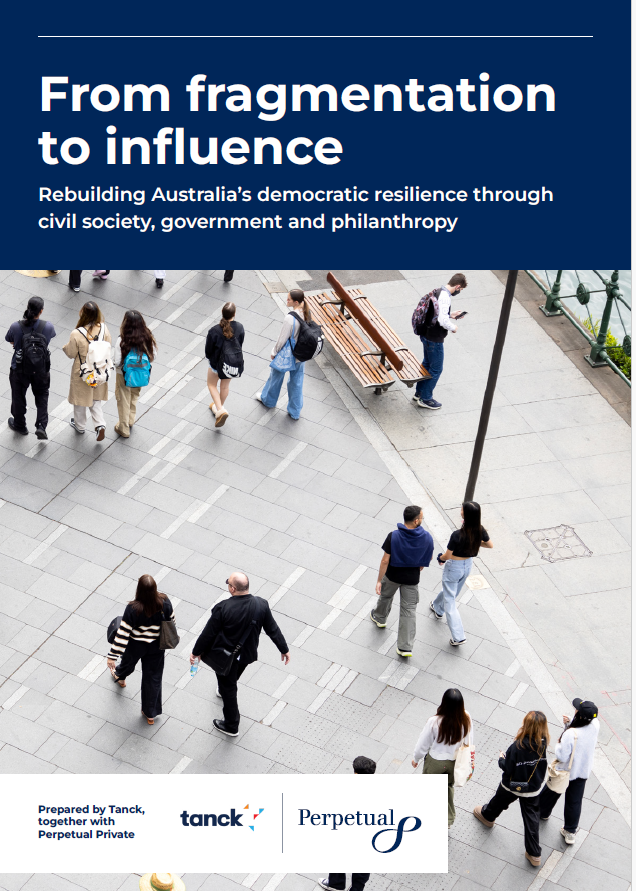
From Fragmentation to Influence
Rebuilding Australia’s democratic resilience through civil society, government and philanthropy
Led by Neil Pharaoh, Tanck has authored a whitepaper together with Perpetual, aimed at helping Australia’s civil society strengthen its advocacy efforts with support of philanthropy.
isn’t a reputational risk – it’s democratic infrastructure. Underfund it, and the system weakens.
Advocacy…
EXECUTIVE SUMMARY
This whitepaper explores how purpose-driven organisations can reclaim their influence in an increasingly volatile world through structured advocacy programs catalysed by philanthropic support. Drawing on global evidence, Australian survey data, real-world case studies and a practical toolkit, it sets out how philanthropists can assess the NFPs they support for their advocacy capability, and how NFPs can strengthen democracy, align with government priorities and secure more sustainable funding.
In Australia, the NFP sector is operating under considerable strain. The operating environment has been reshaped by declining trust in institutions and increasing political and social polarisation, at a time when funding instability and community demand have hit their peak. Tanck surveyed over 150 Australian NFP and philanthropic organisations and over 20 philanthropic advisors from late August to mid-November 2025 to gain deeper insight into the challenges and barriers that prevent purpose-driven organisations from taking a more strategic and less reactive approach to those state goals.

Key findings:
Government engagement: Most organisations engage reactively (69%) rather than strategically, with moderate confidence levels and limited access to decision-makers. Engagement is present but infrequent, and policy coherence is a priority even though results suggest companies lack internal intel.
Funding dependence: A significant reliance on government funding (70%) and recurrent funding (57%) was observed, with advocacy efforts often linked to funding outcomes. Philanthropic support for advocacy work remains minimal.
Advocacy challenges: Short-term funding cycles, workforce shortages, and rising service demand are major barriers. Misconceptions about NFP capacity and administrative burdens further constrain advocacy effectiveness.
Sector conditions: 40% of organisations report being overstretched, and 15% anticipate imminent cuts, signalling operational fragility.
Comparative insights: Larger organisations exhibit greater funding stability and engagement capacity, while smaller organisations face structural constraints and higher vulnerability to policy shifts.
NFPs are increasingly acting as an early warning system in a volatile world. Yet the conditions required for it to perform this function are weakening. Funding and contractual constraints, coupled with fear of reprisal, are muting civic voices at precisely the moment they are most needed.
This paper argues that rebuilding NFPs’ influence as part of wider public institutions is central to democratic resilience. The experience of successful reform efforts — from large-scale national agendas to volunteer-led campaigns — shows that impact is possible when organisations are influence-ready, evidence-driven and committed to long-term relationships. Doing so requires a shift from transactional contracting to collaborative policymaking, supported by philanthropic and institutional partners who invest in readiness, credibility and durable engagement rather than short-term wins.
B Comm, LLB, GAICD
Co-Founder & Director, Tanck
Book an appointment.
Meet with Angus Crowther, Tanck Director and Co-Founder, to discuss your government engagement aspirations, and explore how Tanck can support your organisation.
Alternatively, if you’re looking for further information, take a look at our Resources for a range of tips and insights relating to topics such as budget submissions, letter writing, whether to engage a lobbyist and more.
To book an exploratory meeting please email camilo@tanck.com.au


Australia’s largest NFP survey has revealed the dependence Australia’s not-for-profits have on government, with nearly half reporting being overstretched and more than one in ten braced for imminent cuts.
View our full range of advisory services
-
![]()
Government Engagement
Make talking to government easy and impactful.
-
![]()
Advocacy
Secure funding, policy change, legislative change, and support grant and tender applications.
-
![]()
Election Readiness
Leverage policy, funding, or infrastructure commitments.
-
![]()
Election Checklist
Best practice political tactics for an election.
-
![]()
Communications Services
Strategies for greater messaging and impact.
-
![]()
Stakeholder Management
Navigate complex stakeholder areas.